Get into the festive spirit with these essential French Christmas words!
Learn how to talk about holiday traditions, decorations, and celebrations in French.
Perfect for students and travelers wanting to experience the joy of Noël.
Embrace the holiday cheer while expanding your vocabulary!
In this video, we’ll dive into the essential French vocabulary for vegetables!
Whether you’re shopping at a French market or just improving your language skills, this lesson will teach you the most common vegetable names in French.
With clear pronunciation and easy-to-follow examples, you’ll be able to talk about your favorite veggies like a pro.
Perfect for beginners or anyone looking to expand their French vocabulary!”
In this video, we’ll dive into 10 key French expressions that use the verb aller (to go). As one of the most versatile verbs in French, aller appears in many everyday phrases that can help you sound more fluent and natural.
From ça va (how are you?) to aller chercher (to go get), we’ll break down each expression, its meaning, and show you how to use them in real-life conversations.
If you’re looking to improve your French and speak with confidence, these expressions with aller are a great place to start.
Don’t forget to subscribe for more French lessons and language tips!
Embark on your French learning journey with confidence!
In this video, we’ll share 5 effective strategies to help you master the French language.
From setting realistic goals to incorporating immersive practices, these tips are designed to enhance your learning experience and keep you motivated.
Whether you’re a complete beginner or looking to improve your skills, this road map will guide you every step of the way.
Join us and discover the best ways to learn French efficientl
Mastering French ER verbs is crucial for anyone learning the language! In this video, we’ll walk you through the 10 most important ER verbs and show you exactly how to conjugate them in the present tense.
Perfect for beginners or those looking to refresh their skills, this guide will help you build a strong foundation in French verb conjugation.
Whether you’re a student with French Lessons Australia or studying independently, this tutorial is designed to make learning fun and easy.
Don’t forget to check out our website for more tips and resources to conquer French confidently!
You will discover easy ways to help you understand French adjectives and French grammar rules.
Wouldn’t be amazing to speak without asking yourself if your sentence make sense?
Would you like to find your words easily and express your opinions accurately?
Before starting our grammar journey about adjectives, remember that learning French is fun and easy. Stop telling yourself how hard French is and start focusing on the positive.
Yes, you read that right. Learning French can be easy. There are many simple tools you can use to simplify your French learning and make swift progress in the language.
Take the “hardest” grammar and vocabulary points and make them yours, by following French Lessons Australia Free Lessons.
To start your language journey today, let’s dive into the first thing to know about Adjectives.
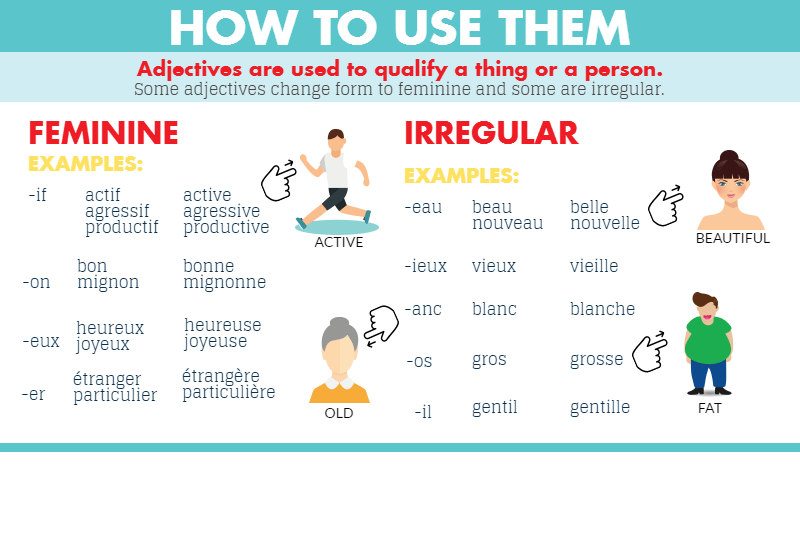
Adjectives are used to qualify a thing or a person.
Grasse est la capitale mondiale des parfums.
(Grasse is the world capital of perfume.)
They agree in gender and number with the noun to which they relate.
In general, they take a -e in the feminine, and a -s in the plural.
– Il est grand et fort. He is big and strong. (masculine singular)
– Elle est grande et forte. She is tall and strong. (feminine singular)
– Ils sont grands et forts. They are tall and strong. (Plural masculine)
– Elles sont grandes et fortes. They are big and strong. (Feminine plural).
Some adjectives change form to feminine. Here is a list.

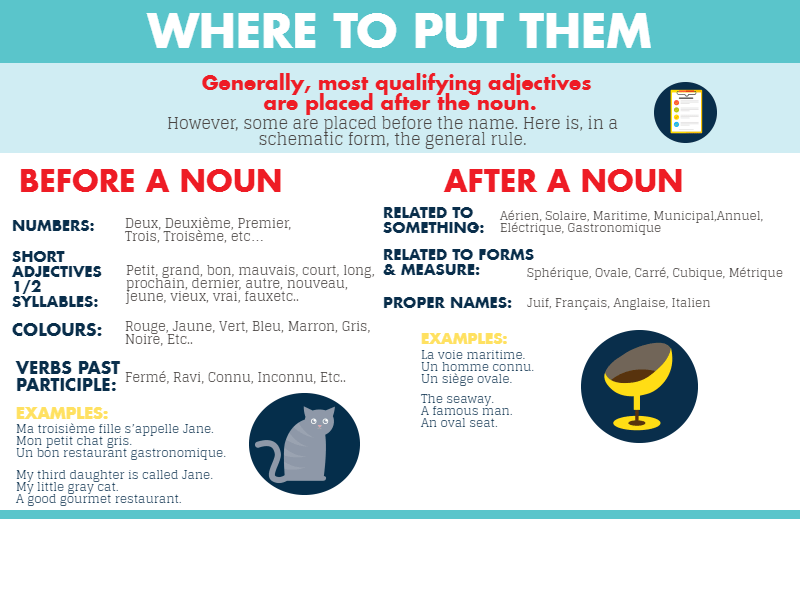
Generally, most qualifying adjectives are placed after the noun.
However, some are placed before the name. Here is, in a schematic form, the general rule.
2.What do we have to do when a noun has two French adjectives or more?1 If the two adjectives normally go before the noun, they go together with an
Ex. A good and nice boy Un bon et gentil garçon.
2 If an adjective goes before the noun and one after, they are both placed after the noun with “and”:
Ex. A good and hearty meal. Un repas bon et copieux.
3 We can put an adjective before and after:
Ex. A beautiful gray hat. Un beau chapeau gris.
4 If the two adjectives normally go after the noun they are placed there with on and
Ex: She is a friendly and sincere woman. C’est une femme amicale et sincère.
Remember We do not put a long adjective before a noun of a single syllable.
That’s all for adjectives.
You have all you need to speak French.If you want more you can go to our website and find out more about French grammar and vocabulary.
If you want to practice your French conversation just enroll in one of our amazing French Lessons.
Do you need to learn this (Falloir)?
It’s totally necessary to understand what “Il faut” is in the French Language.
If you have been to France before or if you know some French friends, you have probably heard these two words over and over again.
Il faut aller faire des courses
We have to go shopping!
Il faut t’habiller chaudement
You must dress warmly.
Il faut faire tes devoirs !
You have to do your homework !
Il faut means a necessity, an obligation. It also can be used to express directions or orders.
Learning French can be tricky but we, at French Lessons Australia are here to help. With this simply online and totally free lesson, you will understand easily how to use the French verb Falloir.
Falloir is an irregular French verb, and it means to need, to be necessary to.
It’s one of the easiest verbs as it is an impersonal one.
It means it has only one conjugation in each tense and mood. Easy! ?
Our today’s French lesson allows you to learn French faster.
Let’s get our feet wet!
Falloir has just one conjugation in each tense and mood. The third person singular which may be followed by either an infinitive or a noun or a subjunctive.
You have to do your homework every day.
You must prepare your things in the evening, if you do not want to be late in the morning.
You have to take a left after the shop.
Il faut que tu fasses tes devoirs !
<pIl faut que tu prépares tes affaires le soir…
Il faut que nous prenions à gauche
Il faut du temps We need time.
Il faut une voiture We need a car.
If you want to make it more personal you can add a pronoun.
Il me faut du temps.
Il nous faut une voiture.
Now you are ready to speak French so enrol in one of our wonderful classes at French Lessons Australia. Whatever you choose conversational class, private tuition we are here to help and we have much to offer click here to get more.
The ”passé composé” is the present perfect tense. This tense is used a lot in French to describe a situation that happened in the past at a definite time but that still has a meaning for today… Seems very theoretical, but really, it is not as you will see soon with French Lessons Australia!
When to use it?
The passé composé is the usual tense for events and incidents that happened in a close past. Unlike the English present perfect, the passé composé is used very often by French people.
Some time indicators can be used in addition to strengthen this relation between past and present! For instance: hier (yesterday), l’autre jour (the other day), samedi passé (last Saturday), plusieurs fois (several times), l’année passée (last year),
As you can see, it is not necessary to be very recent to use the passé composé. As soon as the information is still relevant with today, the passé composé is appropriate.
Obviously, the passé composé is not the only past tense used in French. The imperfect tense and the past simple tense are also used as we will see in another post on French Lessons Brisbane. However, the passé composé is one of the predominant tense in everyday’s language!
How to use it?
The passé composé is, as its name suggests, a compound tense. Which means that it can be compounded with either the auxiliary ‘être’ or ‘avoir’, followed by the past participle of the verb.
The passé composé of most of the French verbs is used with the ‘avoir’.
Let’s take the action of eating. To say that you ate some bread this morning, you will say in French ”j’ai mangé du pain ce matin”. In fact, in English, you could have said either ”I ate some bread”, or ”I have eaten”, or even ”I did eat”. In French, you will only use the passé composé and say ”J’ai mangé”.
The only things you need to know to form the passé composé is the conjugation of the verb ‘avoir’ to the present tense.
J’ai
Tu as
Il/Elle a
Nous avons
Vous avez
Ils/Elles ont
To that, you will need to add the past participle of the verb you want to conjugate. If the verb is regular, its past participle will mostly be regular. Which means you can guess it without having to know it by heart.
For instance, regular verbs ending by ER will have see their ER displaced by a ‘e’. Therefore, acheter (to buy) will be acheté (bought), manger (to eat) will be mangé (eaten), commencer (to start) will be commencé (started).
Regular verbs ending by IR will have their IR displaced by a ‘i’. Therefore, finir (to finish) will be fini (finished), choisir (to choose) will be choisi (chosen).
And finally, regular verbs ending by RE will have their RE displaced by a ‘u’. Therefore, perdre (to lose) will be perdu (lost), attendre (to wait) will be attendu (waited).
Easy, right?
Well, now, as in English, there are a few irregular verbs which will see their past participle changing differently.
For example, etre (to be) will be été (been), pouvoir (to can) will be pu (could), voir (to see) will be vu (seen), apprendre (to learn) will be appris (learnt), rire (to laugh) will be ri (laughed), etc…
If you want to learn more about French tenses, or just to know more about French in general and what we do at French Lessons Australia, don’t hesitate to contact us at info@french-lessons-australia.com