Category
The verb faire, is one of the most used verbs in the French language.
You can translate it in English by “to do” or “to make”, but there are also countless expressions using it with a different meaning. Let’s jump on the French Lessons Brisbane train and learn how to understand this word better…
To do/to make
While in English, people make a distinction between two types of actions using either “to make” or “to do”, French people make it perhaps more simple and only use one verb: Faire.
For instance, to say that your friend makes you smile, you will say ‘mon ami me fait sourire’. Besides, if you want to say that you do your homework every weekend, then you’ll say ‘je fais mes devoirs tous les week-ends’.
In a general way, everytime you want to translate the verbs to do or to make, you can use the verb faire.
Expressions using ”faire”
French people really like this verb and tend to use it quite a lot. It
would be too long (and possibly too boring) to list here all the expressions using ”faire” so French Lessons Australia will only provide you here with the most useful ones:
Talking about the weather: whether it is cold or warm outside, French will say ‘Il fait froid’ (it is cold) or ‘Il fait chaud’ (it is warm). If the weather is nice, you can say ‘Il fait bon’ (it is good), and if the weather is bad you can say ‘Il fait mauvais’ (it is bad).
Talking about the chores: various expressions about chores or sport also use the verb ”faire”. Doing the dishes will be translated by ‘faire la vaisselle’. Doing housework will be ‘faire le menage’. Cooking could be translated by ‘cuisiner’ or ”faire la cuisine’ (to do the kitchen, literally). Going out to buy food will be ‘faire les courses’. If you do a sport, you can always use the verb ”faire” as well: ‘faire du sport’. In this way, swimming can either be translated by ‘nager’ or ‘faire de la natation’. Doing some fitness will be ‘faire du fitness’. Doing bicycle will be ‘faire du velo’, etc…
Some random expressions: when you ask someone to pay attention, you will say ”fais attention” to this person. If you hurt yourself, we use the expression ‘se faire mal’, so in this case you will say ‘je me suis fait mal’. Then, you can also express the fact of becoming very rich: ‘faire fortune’. To explain that something doesn’t matter, you can just say ”ca ne fait rien”. And if you trust someone, you can tell him ‘je te fais confiance’.>
How to conjugate the verb ”faire”
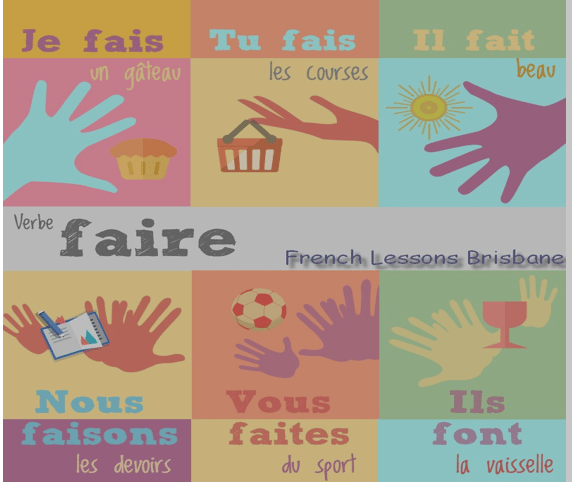
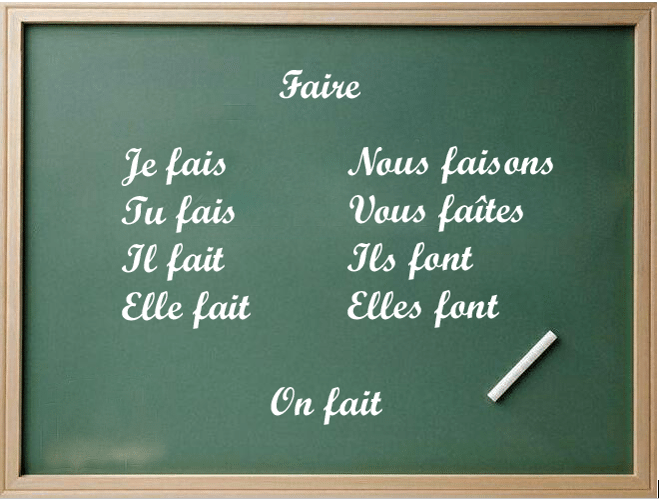
Unfortunately, the verb ”faire”, as most of the very used verbs in French, is an irregular verb.
That means that you will need to know its conjugation by heart, but don’t worry it’s pretty easy!
Je fais = I do, make
Tu fais = You do, make
Il/Elle fait = She does, makes
Nous faisons = We do, make
Vous faites = You do, make
Ils/Elles font = They do, make
This post has been provided by French Lessons Australia, don’t hesitate to contact us via email at info@frenchlessons-australia.com.au